


Gripzzly gloves are Category III Personal Protective Equipment (PPE), designed for professionals and enthusiasts who prioritize safety. Made of high-quality nitrile, they are exceptionally durable, thick, and flexible, guaranteeing effective protection even in the harshest conditions.
They are tear- and abrasion-resistant, making them ideal for the most demanding tasks. They protect against oils, grease, and other chemicals, as well as fungi, bacteria, and viruses. The gloves are latex- and thiuram-free, food-safe, and meet stringent safety standards. Two models are available: Gripzzly and Gripzzly X.


Choose the Gripzzly X if you need the highest level of protection – especially when handling liquids or chemicals. The extended cuff allows for safe, deeper reach and minimizes the risk of liquids getting inside the glove.
Choose this model when maximum durability and a secure grip are key. The diamond texture ensures stability even on wet and oily surfaces, while offering comfort and precision in the most challenging conditions.

anti-slip diamond structure

extended cuff

Safe in contact with food.
Possibility to operate a mobile device without removing gloves from your hands.

Hand protection against dirt and chemicals.
CLICK and learn more about the gloves
Gripzzly up close!
CHOOSE STRENGTH
AND PROTECTION


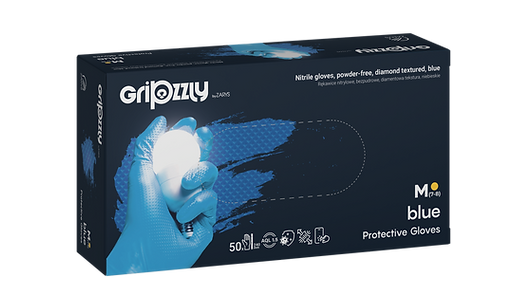


comfort thickness durability

GRRRRRIZZLY POWER
Workshop nitrile gloves
thick and durable nitrile
compliance with the standard
ASTM F 1671 and
from EN ISO 374-5
resistance to fungi, bacteria and viruses
powder-free
and without added latex
personal protective equipment category III (type B)
free from thiurams
resistance to substances
chemicals, greases, oils
safe in contact
with food


HOW TO HUNT GRIPZZLY?
Gripzzly gloves are available at your local distributor. or on popular sales platforms such as Allegro. It's convenient
and proven solutions that allow you to be sure of the security of your purchases.
producer:
ZARYS International sp. z o. o.
Pod Borem 18, 41-808 Zabrze, Poland
tel. +48 32 376 07 50–55


HAVE MORE QUESTIONS?
Workshop nitrile gloves are a completely different league from the thin disposable glove you get at a pharmacy. Anyone who has ever tried to take apart a seized brake caliper wearing an examination glove knows how it ends: the thumb gives out after a quarter of an hour, the hand is covered in oil, and the job stalls. Gripzzly was born from exactly that frustration. These are thick, powder-free nitrile gloves with a diamond texture, designed by ZARYS International from Zabrze with the workshop, the production hall and the garage where something's always happening all weekend in mind.
How workshop nitrile gloves differ from an ordinary disposable glove
The difference isn't just about the material, because nitrile is used in both. It's about how that nitrile was engineered. An examination glove needs to be thin, to give sensitivity during a check-up. A workshop glove needs to survive contact with a sharp sheet-metal edge, a thread, a cable tie and a litre of engine oil, all while not slipping off the tool.
Gripzzly is classified as Category III (type B) Personal Protective Equipment under Regulation (EU) 2016/425 of the European Parliament and of the Council. Category III is the highest level, reserved for hazards that can cause very serious health consequences. This isn't a cosmetic difference from general-purpose Category I gloves, but a different certification path and a different scope of testing.
- Thicker, tougher nitrile, resistant to tearing and abrasion during extended use.
- Diamond texture over the entire surface of the palm and fingers, not just the fingertips.
- Rolled cuff, which doesn't slip off when tugged and makes removal easier.
- Polymerised inner surface, thanks to which the glove goes on without a fight.
- AQL 1.5, i.e. a rigorous level of watertightness control for the production batch.
Thick nitrile in practice: oil, grease and what happens to latex
Nitrile is a synthetic rubber (acrylonitrile-butadiene), and its advantage over latex in the workshop is purely chemical. Latex swells, stretches and loses structure on contact with petroleum derivatives, so the barrier stops being a barrier long before the glove looks damaged. Nitrile keeps its resistance to oils, greases and petrol, which is why it has become the default material in car service shops.
The second argument is dermatological. Gripzzly nitrile gloves are free of latex and free of thiurams. Thiurams are vulcanisation accelerators, for years one of the most common causes of occupational allergic contact dermatitis diagnosed by patch testing. If, after a week wearing gloves, an employee has red, itchy skin on the back of the hands, it's worth checking the composition before looking for the culprit among cleaning products.
Diamond texture, or a grip that doesn't slip away with the oil
The anti-slip diamond structure is Gripzzly's most recognisable feature, and at the same time the hardest one to describe in a photo. The diamond-shaped knurling covers the entire outer surface of the palm and fingers, so you have a secure grip even when holding a part sideways or with two fingers. On a wet, oily surface, the texture breaks up the liquid film, and that's what decides whether the wrench stays in your hand.
On top of that comes a detail missing from most thick work gloves: the ability to operate a smartphone without removing the gloves. In practice, that means you can check the parts catalogue, the wiring diagram, or a photo of the VIN number without taking off your protection and putting it back on with dirty hands.
Four Gripzzly versions and the situations they were designed for
- Gripzzly Orange: orange nitrile gloves for technical and workshop work where the visibility of the operator's hand matters. The colour makes health-and-safety supervision easier in work zones, on construction sites and during assembly work.
- Gripzzly Black: black nitrile gloves for heavily soiling work, where grease and soot instantly change the look of a light-coloured glove. The classic choice for car workshops and machine service.
- Gripzzly Blue: blue nitrile gloves, standing out against almost any background. A colour that contrasts with the surroundings works well wherever visual inspection of hands has procedural importance.
- Gripzzly X Long: nitrile gloves with an extended 300 mm cuff, protecting the hand and forearm. The choice for pouring liquids, washing parts in a tub, and every situation where splashes reach higher than the wrist.
All variants share the same construction and the same tests. The choice comes down to colour, cuff length and what you actually do for eight hours.
Gripzzly nitrile glove parameters in one place
| Parameter | Value |
|---|---|
| Material | 100% nitrile (acrylonitrile-butadiene) |
| Outer surface | polymerised, diamond texture over the entire palm and fingers |
| Inner surface | polymerised |
| Cuff | rolled (300 mm in the X Long version) |
| AQL | 1.5 |
| Classification | PPE category III, type B, per Regulation (EU) 2016/425 |
| Sizes | S, M, L, XL, XXL |
| Unit packaging | 50 pcs. |
| Bulk packaging | 10 packages |
| Additional features | powder-free, latex-free, thiuram-free, approved for contact with food |
| Status | single-use, non-sterile |
Standards on the box: how to read them without an engineering degree
The pictograms on the box look like information noise, yet they're the one part of the description that can't be written for marketing purposes. Gripzzly nitrile gloves comply with the requirements of the following standards: EN ISO 374-1:2016+A1:2018, EN 374-2:2019, EN 374-4:2019, EN ISO 374-5:2016, EN 16523-1:2015+A1:2018, EN ISO 21420:2020 and EN 388:2016+A1:2018. Below is the translation into workshop language.
- EN ISO 374-1, type B: resistance to permeation for at least 30 minutes for a minimum of three chemicals from the test list. Type A requires six, type C only one, at ten minutes.
- EN 374-2: watertightness test, i.e. resistance to penetration through micro-holes and cracks.
- EN 374-4: material degradation under chemical exposure, because a glove can lose its properties before anything actually breaches it.
- EN ISO 374-5: protection against micro-organisms, including resistance to fungi, bacteria and viruses.
- EN 388: mechanical hazards, i.e. abrasion, cut, tear and puncture.
- EN ISO 21420: general requirements, ergonomics and safety of the product itself.
- ASTM F1671: test method for resistance to blood-borne pathogens, using the Phi-X 174 bacteriophage.
Worth remembering separately: AQL 1.5. This is the acceptable quality level, determined by a watertightness test on a sample from the batch. The lower the figure, the fewer non-conforming products are allowed in the tested sample. If a manufacturer doesn't state an AQL, you have no declared information about watertightness at all, and when working with hazardous substances that's not a minor detail. The Gripzzly manufacturing process is run in accordance with the US FDA Quality System Regulation, BS EN ISO 9001 and EN ISO 13485.
Who reaches for workshop nitrile gloves most often
- Car and motorcycle workshops: oil changes, brakes, suspension, service chemicals.
- Maintenance and machine service: greases, gearboxes, assembling and disassembling components.
- Chemical and pharmaceutical industry: contact with irritating substances and the need for frequent glove changes.
- Construction, installation and assembly work: adhesives, foams, mortars, sharp edges.
- Catering and food processing: the gloves are approved for contact with food.
- Agriculture and smallholdings: operating machinery, oils, maintenance tasks.
- Home garage and DIY: renovation, restoration, paintwork, weekend mechanics.
Size, consumption and common sense when ordering
Gripzzly comes in sizes from S to XXL, so sizing is simpler than with coated gloves, where numbering is sometimes arbitrary. There's one rule: the glove should fit snugly but not stretch the skin when the fist is clenched. Too large and it bunches up under a tool, reducing precision; too small and it tires the hand and splits at the knuckles.
For company orders, it's worth calculating actual consumption rather than copying last year's line item from an invoice. Unit packaging is 50 pieces, the bulk carton is 10 packages, meaning 500 gloves. A workstation that changes gloves after every job can get through a package in three days. And one more thing that's talked about too rarely: disposable gloves are disposable. Disinfecting with alcohol and reusing them is a practice that degrades the material and voids the declared protection.
Frequently asked questions about workshop nitrile gloves
Are Gripzzly nitrile gloves resistant to petrol and oils?
The product is designed to protect hands against hazardous substances contained, among others, in greases and oils, and type B classification per EN ISO 374-1 means confirmed resistance to permeation for at least 30 minutes for a minimum of three test chemicals. For a specific substance, always check the safety data sheet and the product's declaration of conformity.
Can workshop nitrile gloves be used with food?
Yes, Gripzzly gloves are approved for contact with food. It's the same glove a mechanic uses, so in a facility combining production and maintenance it simplifies inventory management.
Do the gloves contain powder or latex?
No. They are powder-free, without added latex, and free of thiurams, which reduces the risk of irritation and delayed-type allergic reactions.
Are Gripzzly gloves sterile?
No. The product is non-sterile and single-use, and is not intended for use in sterile conditions.
How does Gripzzly X Long differ from the standard version?
With an extended cuff, 300 mm long. It protects not just the palm but also the forearm, and noticeably reduces the risk of liquid getting inside the glove when reaching deep into a tank or a washing tub.
Can I use a phone while wearing these gloves?
Yes. The design allows smartphone use without removing the gloves from your hands.
Where to buy Gripzzly nitrile gloves
Gripzzly nitrile gloves are available from local distributors and on popular sales platforms: Allegro, Morele and Ceneo. The brand's manufacturer is ZARYS International sp. z o.o., ul. Ziemska 44, 41-803 Zabrze, tel. +48 32 376 07 50-55.
If you're looking for workshop nitrile gloves for a team, not just one pair for Saturday, start by asking about the real hazards at the workstation: is it mostly oil, chemicals, or sharp edges, and how high up do hands get exposed. The answer to that question will point to the right Gripzzly variant faster than any price comparison site.